02 September 2024
Unlocking the Future of Urban Planning with 3D Digital Twins
Categories:
Urban planners face a persistent challenge: making infrastructure decisions based on spreadsheets and static renderings while stakeholders struggle to visualize the real-world impact. Digital twin technology addresses this gap by creating interactive, data-rich models that bridge the divide between abstract planning and tangible outcomes.

Urban planners face a persistent challenge: making infrastructure decisions based on spreadsheets and static renderings while stakeholders struggle to visualize the real-world impact. Digital twin technology addresses this gap by creating interactive, data-rich models that bridge the divide between abstract planning and tangible outcomes.
What Are Digital Twins in Urban Planning?
A digital twin is a virtual replica of a physical environment that integrates real-time data to mirror actual conditions. In urban contexts, this means creating a comprehensive 3D model of a city that captures not just visual geometry but operational dynamics. Think of it as the difference between a photograph and a living organism.
The distinction matters because traditional planning tools present information in formats that require significant interpretation. A 3D visualization might show what a development looks like, but a digital twin shows how it functions within existing infrastructure, responds to traffic patterns, and integrates with utility systems.
What Components Define a Functional Digital Twin?
Digital twins combine several technical elements to create their utility. The foundation is three-dimensional geometry that accurately represents physical structures. This goes beyond aesthetic modeling to capture precise measurements, material properties, and spatial relationships.
Real-time data integration distinguishes digital twins from static models. Sensors, IoT devices, and connected systems feed information continuously. Traffic flow changes throughout the day. Weather affects infrastructure performance. Usage patterns shift seasonally. A functional digital twin reflects these variables as they occur.
Interactivity allows stakeholders to explore scenarios and test assumptions. Users can adjust variables, simulate changes, and observe cascading effects across systems. This transforms planning from a linear process into an iterative exploration where decisions can be validated before implementation.
How Do Digital Twins Differ From Traditional 3D Models?
The critical difference lies in the feedback loop. A traditional architectural visualization presents a fixed vision at a specific moment. Digital twins maintain continuous connections to data sources and update accordingly.
Consider a proposed transit hub. A standard rendering shows the completed structure. A digital twin incorporates ridership data, connects to existing transportation networks, models crowd flow during peak hours, and simulates emergency evacuation scenarios. The model becomes a testing ground for operational questions that emerge long after initial design approval.
This capability matters most when planning decisions carry significant financial risk or public impact. Infrastructure investments represent decades of use. The ability to explore performance under various conditions before breaking ground reduces costly corrections later.
Why Are Cities Adopting Digital Twin Technology?
Urban environments generate enormous amounts of data that rarely converge into actionable intelligence. Traffic sensors, building management systems, utility meters, and public services each operate within separate silos. Digital strategy increasingly focuses on integration, and digital twins provide the framework.
What Planning Challenges Do Digital Twins Address?
Infrastructure decisions involve multiple stakeholders with competing priorities. Developers focus on feasibility and returns. City planners consider long-term urban growth patterns. Residents care about livability and access to services. Transportation authorities need to maintain flow. Environmental agencies monitor sustainability impacts.
Traditional planning processes struggle to reconcile these perspectives because each group reviews the same project through different analytical lenses. A digital twin creates a shared reference point where all stakeholders examine the same model with their specific concerns visible simultaneously.
The visual nature of digital twins also accelerates understanding. Municipal planning documents run hundreds of pages. Few people outside specialized roles can extract meaningful insights from zoning codes and impact assessments. An interactive model makes implications tangible. A proposed high-rise's effect on sight lines, shadow patterns, and pedestrian flow becomes immediately apparent.
How Does Real-Time Data Integration Improve Decision Making?
Static planning tools freeze assumptions at the moment of analysis. Actual conditions evolve continuously. A digital twin remains current by ingesting data streams that reflect operational reality.
Traffic patterns exemplify this advantage. Historical averages provide baseline information, but they miss variations caused by construction, events, weather, or changing commute patterns. A digital twin connected to live traffic data shows current conditions and can model how proposed changes would perform under those specific circumstances rather than theoretical averages.
This becomes especially valuable for testing interventions before implementation. Cities can simulate new bike lane configurations, revised traffic signal timing, or pedestrian zone expansions within the digital twin to observe effects on overall flow. The model identifies bottlenecks and unintended consequences that wouldn't emerge from standard traffic studies.
What Technology Enables Advanced Digital Twins?
Creating effective digital twins requires sophisticated rendering capabilities and data processing infrastructure. The visual fidelity needs to support detailed inspection while maintaining performance for real-time interaction. The data architecture must handle continuous streams from numerous sources while keeping the model responsive.
Why Do Development Teams Use Game Engine Technology?
Game engines like Unreal Engine provide the rendering performance and interactivity framework that digital twins require. These platforms were designed to create immersive environments where users navigate freely and objects respond dynamically. Those same capabilities translate directly to urban planning applications.
The advantage extends beyond performance. Game engines include extensive libraries of photorealistic materials, lighting systems that accurately simulate natural and artificial illumination, and physics engines that model real-world behavior. A planner exploring a digital twin can observe how morning sunlight affects a plaza, how wind patterns move through building corridors, or how pedestrian traffic distributes across available paths.
These engines also support collaborative review. Multiple stakeholders can access the same model simultaneously, each exploring from their perspective while maintaining a shared understanding of the environment. This mirrors how UX research approaches collaborative discovery, creating spaces where diverse perspectives inform better outcomes.
What Role Does Photorealistic Rendering Play?
Visual accuracy matters because it affects stakeholder confidence in the model. A stylized or abstract representation requires mental translation. Viewers must imagine how the actual result would differ from what they see. Photorealistic rendering eliminates that gap.
The practical benefit emerges during approval processes and public consultations. Community members evaluating a development proposal can see precisely how it would appear from their perspective. Concerns about scale, aesthetics, and neighborhood integration become concrete rather than speculative. This tends to produce more substantive feedback than reactions to technical drawings or simplified models.
For development teams working on architectural animations, the ability to generate marketing content directly from the planning model creates efficiency. The same asset used for technical analysis can be adapted for investor presentations, public outreach, or promotional materials without rebuilding from scratch.
How Do Digital Twins Support Infrastructure Development?
Infrastructure projects operate under significant constraints. Budgets are fixed. Timelines are aggressive. Disruption to existing services must be minimized. Public scrutiny is intense. Digital twins help navigate these constraints by making trade-offs explicit and testable.
What Types of Infrastructure Benefit Most From Digital Twin Implementation?
Transportation hubs demonstrate particularly strong returns from digital twin adoption. Airports, train stations, and transit centers involve complex interactions between passenger flow, baggage handling, security screening, retail operations, and connecting services. Changes to any component ripple through the entire system.
A digital twin allows operators to test modifications in isolation and observe system-wide effects. Relocating security checkpoints might reduce congestion in one area while creating bottlenecks elsewhere. Adding retail space could improve passenger experience but complicate circulation during peak periods. The model reveals these interactions before they affect actual operations.
Port facilities face similar complexity with the added challenge of coordinating vessel movements, cargo handling, storage allocation, and ground transportation. A digital twin helps optimize berth assignments, predict congestion, and plan capacity expansions based on projected shipping volumes. The same model supports emergency response planning by simulating evacuation scenarios or hazardous material incidents.
Mixed-use developments benefit from digital twins by modeling how residential, commercial, and public spaces interact throughout daily and seasonal cycles. This informs decisions about parking allocation, service access, shared amenities, and public transit connections.
How Do Digital Twins Facilitate Stakeholder Collaboration?
Large infrastructure projects involve dozens of organizations with distinct responsibilities and priorities. Coordinating these groups typically requires extensive meetings, document circulation, and revision cycles. Misunderstandings about scope, interfaces, and sequencing lead to delays and cost overruns.
A shared digital twin reduces coordination friction by creating a single source of truth. When questions arise about how systems connect or spaces overlap, stakeholders reference the model rather than exchanging conflicting drawings. This is similar to how custom CRM solutions centralize customer information to eliminate data fragmentation.
The model also documents decisions over time. As the project evolves, the digital twin captures changes and maintains history. This prevents the common problem of lost institutional knowledge when team members change or consultants complete their scope. Future maintenance teams inherit a comprehensive record of how the facility was designed and built.
What Applications Extend Beyond Urban Planning?
While cities represent the most visible application of digital twin technology, the underlying principles apply wherever complex systems require monitoring, analysis, or optimization.
How Do Industrial Facilities Use Digital Twins?
Manufacturing plants employ digital twins to optimize production lines, predict equipment failures, and plan facility modifications. The model incorporates machine specifications, process flows, material handling systems, and quality control checkpoints. Operators can test production schedule changes, evaluate new equipment placement, or simulate emergency shutdowns without disrupting operations.
Energy facilities use digital twins to model distribution networks, predict demand patterns, and coordinate maintenance activities. The integration of renewable sources adds complexity because solar and wind generation fluctuates with weather conditions. A digital twin helps grid operators balance variable supply with changing demand in real time.
What Role Do Digital Twins Play in Real Estate Development?
Property developers face substantial risk during the period between initial investment and project completion. Market conditions shift. Construction costs fluctuate. Buyer preferences evolve. Digital twins reduce some of this uncertainty by enabling better communication with potential buyers and more accurate project planning.
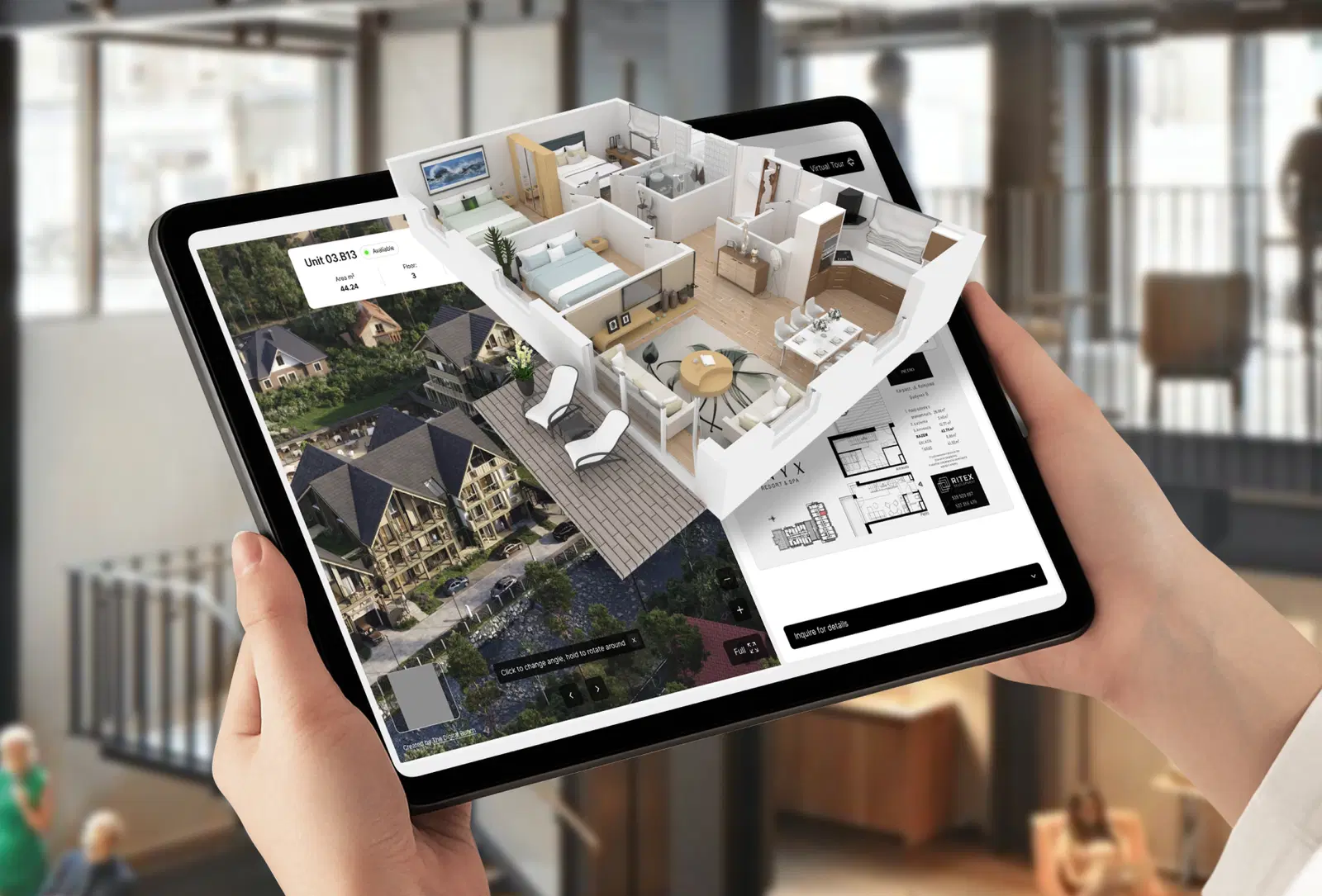
For interactive real estate solutions, digital twins allow buyers to explore properties before construction begins. They can visualize different finishing options, furniture arrangements, and view orientations. This accelerates pre-sales and provides developers with validated demand data before committing to construction expenditures.
The same model supports construction coordination by identifying conflicts between building systems before installation. Mechanical, electrical, and plumbing systems often compete for the same spatial envelope. Resolving these conflicts in the digital twin is substantially cheaper than modifying installed work.
How Do Tourism and Hospitality Sectors Leverage Digital Twins?
Theme parks and resort developments use digital twins to design guest experiences and optimize operational flow. These environments must balance capacity, queue management, food service, retail, and entertainment while maintaining the intended atmosphere.
A digital twin allows operators to simulate different guest density scenarios, test queue routing alternatives, and evaluate new attraction placements. The model can incorporate guest behavior patterns learned from existing facilities to predict how visitors will move through the environment. This informs decisions about pathway widths, amenity placement, and staff positioning.
Museums and cultural institutions use similar approaches to manage visitor flow, plan exhibitions, and optimize spatial utilization. The digital twin helps balance conservation requirements with accessibility and educational programming.
What Challenges Complicate Digital Twin Implementation?
Despite their advantages, digital twins involve significant technical complexity and organizational change. Success requires addressing several persistent challenges.
What Data Quality Issues Affect Digital Twin Accuracy?
Digital twins are only as reliable as their underlying data. Poor data quality produces misleading models that can lead to worse decisions than traditional approaches. The saying "garbage in, garbage out" applies with particular force.
Sensor calibration presents an ongoing challenge. Devices drift over time, requiring periodic validation against known standards. Different sensors measuring the same phenomenon may report conflicting values. The data integration layer must identify and reconcile these discrepancies.
Data gaps create additional problems. Incomplete coverage means the digital twin accurately represents some areas while extrapolating or assuming conditions in others. Users may not distinguish between directly measured values and interpolated estimates, leading to misplaced confidence in model outputs.
Maintaining data quality requires governance processes that most organizations lack. Someone must own data accuracy, establish validation procedures, and coordinate corrections when issues emerge. This organizational capability often proves harder to implement than the technical infrastructure.
How Do Organizations Address the Skills Gap for Digital Twin Development?
Creating and maintaining digital twins demands expertise in 3D modeling, real-time rendering, data engineering, and domain-specific knowledge about the system being modeled. Few professionals combine all these skills.
Development teams typically assemble cross-functional groups that include 3D artists for geometry creation, software developers for data integration and interactivity, and subject matter experts who understand the physical environment. Coordinating these disciplines effectively requires UX design thinking to keep the end user's needs central.
The skills gap extends to the organizations adopting digital twins. Planners, engineers, and operators must learn to work with interactive 3D environments rather than traditional documents and drawings. This requires training and changes to established workflows. Resistance to these changes often impedes adoption more than technical limitations.
What Cost Considerations Affect Digital Twin Projects?
Initial development costs for digital twins are substantial. Creating accurate 3D geometry requires either extensive surveying of existing conditions or detailed modeling of planned developments. Data integration infrastructure involves sensors, connectivity, processing servers, and software licenses. Ongoing maintenance demands continuous attention to keep models current.
These costs must be weighed against the value of improved decision making. For large infrastructure projects where design changes during construction are extremely expensive, digital twins often justify their investment by catching conflicts early. For smaller projects or organizations with limited capital, the cost-benefit calculation may not favor digital twin adoption.
Operating costs also deserve consideration. Digital twins require computational resources to process data streams and maintain interactivity. Cloud infrastructure can scale to meet demand but involves recurring expenses. Some organizations prefer on-premise deployment for data security or performance reasons, which requires capital investment in hardware.
How Will Digital Twin Technology Evolve?
Current digital twin implementations represent early steps toward more comprehensive capabilities. Several trends suggest where the technology is heading.
What Role Will Artificial Intelligence Play in Future Digital Twins?
Machine learning algorithms can identify patterns in the data streams that feed digital twins. These patterns might reveal early indicators of equipment failure, predict traffic congestion before it manifests, or optimize energy consumption based on usage patterns.
The integration of artificial intelligence with digital twins moves beyond passive monitoring toward active optimization. The system doesn't just show current conditions but suggests interventions to improve outcomes. An intelligent traffic management system connected to a city digital twin could adjust signal timing dynamically to minimize congestion based on real-time conditions.
Predictive maintenance represents another valuable application. By analyzing performance data over time, AI models can estimate when components are likely to fail and schedule preventive maintenance before breakdowns occur. This reduces downtime and extends asset life.
How Might Extended Reality Integration Change Digital Twin Interaction?
Virtual and augmented reality provide more immersive ways to experience digital twins. Instead of viewing the model on a screen, users could walk through the virtual environment or overlay digital information onto physical spaces.
For construction coordination, workers could wear AR headsets that display the digital twin aligned with the actual site. This reveals hidden infrastructure, highlights installation points, and flags conflicts between planned and existing conditions. The technology reduces errors caused by misinterpreting drawings.
Training and emergency response simulation also benefit from immersive interaction. First responders could practice navigating complex facilities using the digital twin, building familiarity before actual incidents occur. Facility operators could rehearse rare but critical procedures in a risk-free environment.
What Standardization Efforts Will Improve Digital Twin Interoperability?
Current digital twin implementations often use proprietary formats and custom integration approaches. This creates barriers when organizations want to exchange models or combine data from multiple sources. Industry standards would improve interoperability and reduce development costs.
Several organizations are working toward common frameworks for digital twin data structures, interfaces, and metadata. Wide adoption of these standards would allow components from different vendors to work together more seamlessly, similar to how web standards enable different browsers to display the same content.
Standardization also helps with long-term maintenance. Proprietary systems risk obsolescence when vendors discontinue products or go out of business. Open standards provide more confidence that digital twins built today will remain accessible decades into the future.
What Should Organizations Consider Before Implementing Digital Twins?
Given the investment required, organizations should approach digital twin adoption strategically rather than treating it as a pure technology decision.
How Do You Identify High-Value Digital Twin Use Cases?
Start by examining decisions where better information would meaningfully improve outcomes. Look for situations involving multiple stakeholders with different perspectives, scenarios where the cost of errors is high, or environments where changes need to be tested before implementation.
Avoid adopting digital twins simply because the technology exists. The tool should address specific problems or enable new capabilities that matter to the organization. A content strategy approach works well here: define objectives first, then select technologies that support those objectives.
Pilot projects allow organizations to validate assumptions before committing to enterprise-wide deployment. Choose a contained scope where success can be demonstrated and measured. Use lessons learned to refine the approach before expanding.
What Organizational Changes Support Digital Twin Success?
Technology alone rarely drives transformation. Organizations need to adapt processes, train people, and sometimes restructure responsibilities to realize digital twin benefits.
Decision-making processes may need revision to incorporate insights from the digital twin. If the model reveals problems but the organization continues following established procedures without adjustment, the technology adds cost without value. Building feedback loops that connect digital twin insights to actual decisions is essential.
Data governance becomes more critical. Someone must own the digital twin, ensure data quality, coordinate updates, and manage access. Without clear ownership, models become outdated or fragmented as different groups maintain separate versions.
How Do You Measure Digital Twin ROI?
Return on investment for digital twins comes from avoiding costs, accelerating timelines, and enabling better decisions. These benefits can be difficult to quantify precisely because they involve counterfactuals. What would have happened without the digital twin?
Track specific instances where the digital twin identified problems before they became expensive. A design conflict caught in the model before construction begins saves the cost of rework plus schedule delays. Document these cases to build the business case for continued investment.
Monitor time savings in coordination and decision-making processes. If stakeholder reviews that previously required multiple meetings can be conducted more efficiently using the digital twin, that represents measurable value. Similarly, faster permitting or public approval processes have quantifiable benefits.
Consider qualitative benefits as well. Improved stakeholder confidence, better public engagement, and enhanced organizational capability may not appear directly in financial metrics but contribute to long-term success.
Where Does Digital Twin Technology Fit in Modern Planning Practice?
Digital twins represent a significant advance in how we model and understand complex systems, but they don't replace traditional planning disciplines. They augment human expertise by making information more accessible and interactions more tangible.
The technology works best when integrated into existing practices rather than treated as a complete replacement. Experienced planners still need to interpret what the model shows, weigh trade-offs, and consider factors that don't appear in quantitative data. Digital twins make their expertise more effective by providing better tools for analysis and communication.
As with any significant technology adoption, success comes from matching capabilities to genuine needs, investing in the supporting organizational infrastructure, and maintaining realistic expectations about what the technology can achieve. Digital twins offer substantial potential for improving infrastructure development and urban planning, but realizing that potential requires thoughtful implementation and ongoing commitment.
The future of urban planning increasingly involves dynamic, data-rich models that bridge physical and digital environments. Organizations that develop capabilities in this area position themselves to participate in that future. Those that wait risk finding themselves at a disadvantage as digital twins become standard practice. The question is not whether to engage with the technology, but when and how to begin that journey.
Keep reading
CGI
Business
1/10
The Benefits of 3D Walkthroughs for Architects and Clients
08 August 2023
CGI
Business
The Benefits of 3D Walkthroughs for Architects and Clients
08 August 2023

CGI
2/10
The Importance of Lighting in Architectural Visualization
13 July 2023
CGI
The Importance of Lighting in Architectural Visualization
13 July 2023

CGI
3/10
Should You Choose 3D Product Renders or Professional Photography for Your Brand?
16 February 2026
CGI
Should You Choose 3D Product Renders or Professional Photography for Your Brand?
16 February 2026

CGI
4/10
How Cross-Industry Visualization Techniques Are Changing What's Possible in Architectural and Product Marketing
02 October 2024
CGI
How Cross-Industry Visualization Techniques Are Changing What's Possible in Architectural and Product Marketing
02 October 2024

CGI
5/10
How Do Successful Visualization Studios Build Sustainable Growth?
09 October 2023
CGI
How Do Successful Visualization Studios Build Sustainable Growth?
09 October 2023
CGI
6/10
How to UX/UI Design a 3D Configurator That Makes Sense?
11 January 2026
CGI
How to UX/UI Design a 3D Configurator That Makes Sense?
11 January 2026
CGI
Marketing
7/10
Why Real Estate Property Launches Fail Without Integrated Communication
09 April 2025
CGI
Marketing
Why Real Estate Property Launches Fail Without Integrated Communication
09 April 2025

CGI
8/10
How AI Is Changing Architectural Visualization (And What It Cannot Replace)
28 September 2025
CGI
How AI Is Changing Architectural Visualization (And What It Cannot Replace)
28 September 2025

CGI
Marketing
9/10
How Architecture Firms Should Structure Visualization Capability in 2026: In-House, Outsourced, or Hybrid?
03 February 2026
CGI
Marketing
How Architecture Firms Should Structure Visualization Capability in 2026: In-House, Outsourced, or Hybrid?
03 February 2026
-1.png?width=1200&quality=75&format=webp)
CGI
10/10
How Does Architectural Visualization Work in Saudi Arabia's Vision 2030 Real Estate Market?
23 November 2025
CGI
How Does Architectural Visualization Work in Saudi Arabia's Vision 2030 Real Estate Market?
23 November 2025
1/10